
An introduction to interference.
The most peculiar observation of light is that, depending on what you are looking for, light seems to behave as either a particle (a photon) or a wave. For a particle, imagine that there is a mass-less baseball flying through the air – it won’t feel gravity, but if it hits a wall it will still stop. For a wave, image that ball just fell into a pool of a water and rings appeared to be propagating outward. Still, gravity won’t bring those waves down, but if you blocked part of the wave with a wall, the rest would still go around it. Quickly, it is clear that there are some interesting things going on.
Even though a water wave is a nice visualization for a light wave, the electromagnetic light wave is very different. In our picture, a water wave starts with an oscillating ball and travels outward in water. An electromagnetic wave starts with an oscillating electron and travels ideally unperturbed though a vacuum. The electromagnetic wave itself can be understood simply as an input that would cause a stationary electron to begin to oscillate.
Light is the input that makes an electron oscillate.
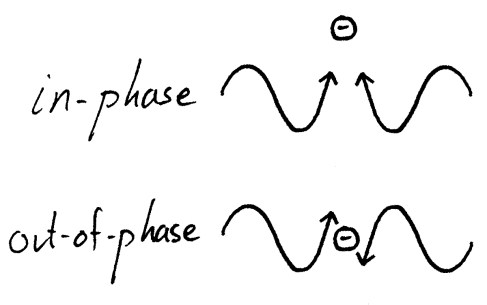
Now is when things get really cool. What would happen if there was light coming from both the left and the right, and electron in the middle – does the electron oscillate? The answer depends on the phase, or the position of the waves (for example, peaks or troughs) relative to each other. If two peaks overlap the electron is pushed higher and, correspondingly, if two troughs overlap the electron is pushed lower. In those cases the light is “in-phase”. But, if a peak and a trough overlap, the electron doesn’t move and the light is called “out-of-phase”. In the latter case, since the electron doesn’t move, there is no light!
Thomas Young is famous for exposing the wave-properties of light with his two-slit interference experiment. The idea is simple: shine light onto two closely spaced thin slits in a metal film and see what light hits a screen after passing through the slits. If light is a particle then we expect to see only two bright lines on the screen, representing the slits, since the rest of the light is blocked. But we don’t see that, instead we see alternating bright and dark spots spreading out on both sides of the slit – an interference pattern. This is amazing! We have two light sources (one from each slit) and together they can produce pure darkness!
What we are actually seeing is the overlap of two spherical waves, one originating from each slit. To visualize the interference pattern, consider a ball oscillating in water. But this time, consider two balls next to each other. Each ball creates an expanding spherical wave and, as you look farther from the balls the waves will begin to overlap. As before, the waves add such that if two peaks overlap the peak gets bigger while if a peak and a trough overlap, they cancel each other such that there appears to be no wave at that point.
Just like the expanding spherical water wave, as a light wave travels it goes through more up-to-down oscillations and therefore acquires more phase (effectively, the number of oscillations). So, even though the light may start from a single source (for example, a slit), by the time it reaches the screen, some of the light has traveled further.
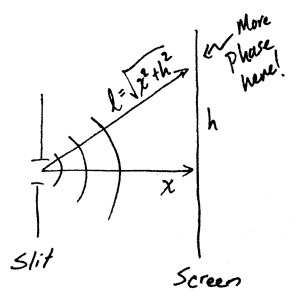
Light from a point is an expanding spherical wave.
Images and Holograms
Every point that we see when we look around is actually the image of a point source of light emitting a spherical wave. The lens in our eye (or camera) collects as much of that wave as possible and sends it back to a point on our retina (or film) and through interference makes an image. The key is that when the image is recorded it loses its phase and only intensity, or simply put the number photons, remains.
This becomes clear if you look through a camera with a manual focus. Before you take the photograph you can choose what objects are in focus (for example, a tree or the mountains behind the tree), but after the image is recorded the focus cannot be changed. The same is true for your eyes when you choose to look at the tree or the mountain behind it, you always choose where to focus.
Images discard phase information, they cannot be refocused.
Getting to holography, the story is a little different. A hologram records all of the phase information. That means that when you look at a hologram of the tree and mountains, your eye can focus on either the tree or mountain, just as you can in real life. Full three-dimensional scenes can be reproduced.
 Photon Report
Leave a comment