The fundamental properties of light, outlined and put into perspective.
As I have discussed, and will discuss, in my other posts, light has fundamental properties – for example, color. Here, I will outline these properties and put them into perspective. Details will be explored more in other posts.
Particle versus Wave
Perhaps the best place to start is questioning what is light – it can be both a particle and a wave.
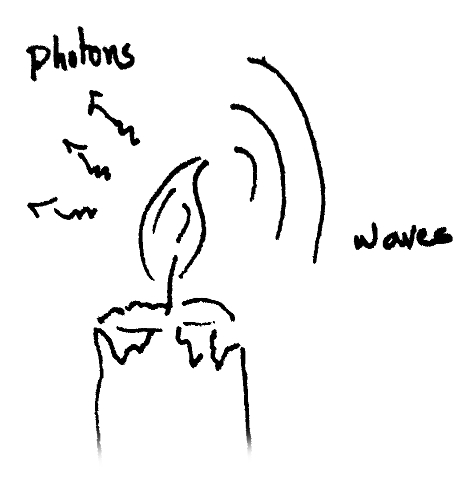
A single particle of light is called a photon. One photon can be seen but more and more photons make something brighter and brighter. To give you an idea of how many photons we see, a 100 W lightbulb emits about a sextillion photons every second. That means a billion trillion photons every second – a number so big it really just makes no sense at all. But, for fun, 1,000,000,000,000,000,000,000 photons every second.
A wave, on the other hand, is not quantized like a particle but instead describes a collective set of photons traveling through space. Waves are helpful to understand how light is created and detected. If we imagine a ball oscillating up and down in a pool, we can visualize waves propagating outwards that will, correspondingly, make a second stationary ball start to oscillate up and down. The same is true for a light wave, except instead of an oscillating ball we generally consider an oscillating electron, and instead of water a light wave travels though space. The fact that light is a wave means that it also has phase.
The Speed of Light
Not only does light travel, it travels fast! That means when you shine a flashlight on a wall, the light is created in the flashlight and travels from the flashlight to the wall. Then, in fact, it travels back to your eye so that you can see it. All of this happens in a fraction of a second, far faster than we can perceive. But how fast?
In air, light always travels at the same speed – the speed of light. Light is so fast that it can travel around the Earth nearly 24 times each second!
But, the speed of the light is slower in different materials. Just as you can’t run as fast in water as you can in air, light also slows down in water. It slows down even more in glass. But, for each material, light always travels the same speed. And it still travels fast. The change in speed through different materials can be used to make light bend, enabling glass lenses but also cool optical effects like a straw in a water glass.
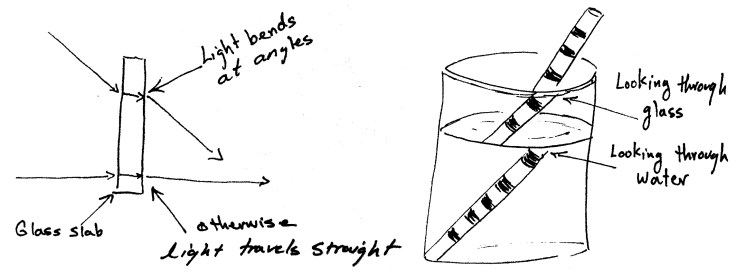
(A hint: A cylindrical glass filled with water is a water lens.)
Color, Energy, Frequency, and Wavelength
These four are connected. Our eyes perceive color and so we are comfortable using that as the standard quantity. But in fact, color is a measure of the energy of a photon which equivalent to the oscillation frequency of the emitting electron. And, since we know how fast light travels, we generally talk about wavelength: wavelength is the distance that light travels in the time it takes for a single wave oscillation.
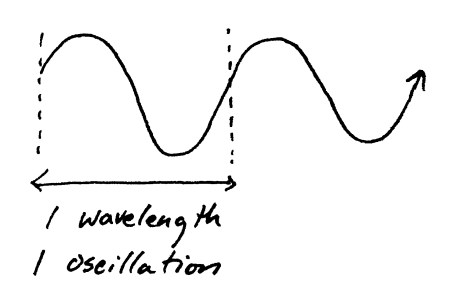
To put some number here, an electron will oscillate a million billion times a second to produce visible light. The wavelength of light is about 200 times smaller than the thickness of human hair. And the energy of a single photon is really, really small (think back to the number of photons that come from a lightbulb). Below is the color spectrum, in terms of energy and wavelength, for visible light.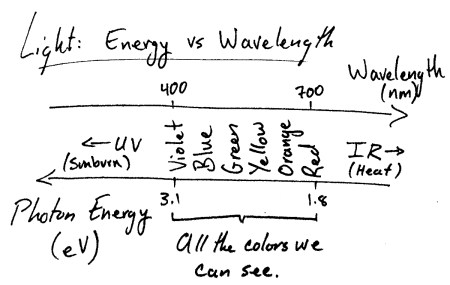
 Photon Report
Leave a comment