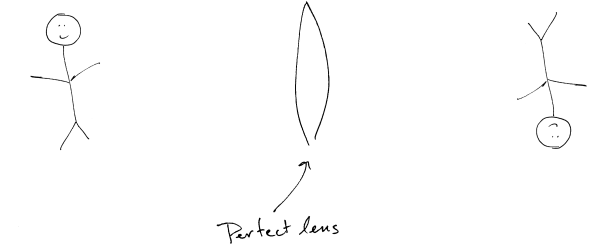
An introduction to imaging
We’ve talked about light and its properties, and even microscopy, but we skipped over the basics of imaging: the way we see the world around us. An image is a visual representation of an object and, in fact, we always see images of objects, not the object themselves. When light travels to an object (let’s consider light traveling from a lightbulb to a stick figure), some of the light is absorbed (that is, it physically heats the object) and some is scattered away from the object. The scattered light goes in all directions and to see the object we must collect the scattered light and form an image. The lens in our eye does exactly that: it captures the light and directs it back together to form the image on our retina. Images can be formed of a whole scene at one moment in time (as just described) or point-by-point as is more common in microscopy.

 Photon Report