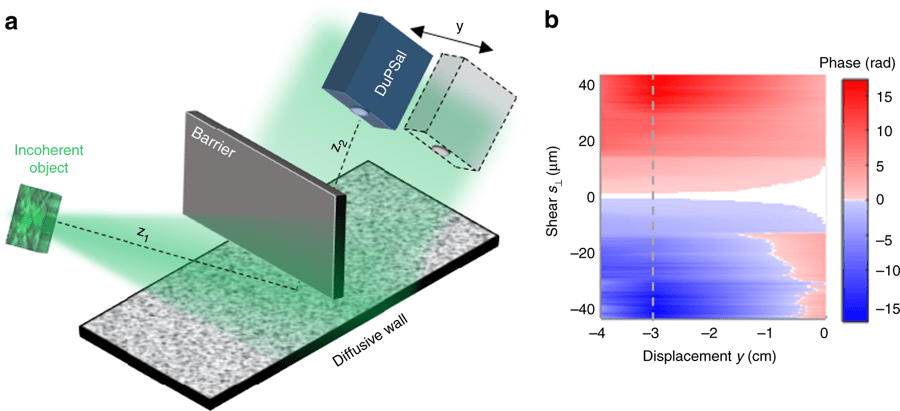
You can’t see objects through a wall, but imagine you can see around a corner, or maybe two. While this has been demonstrated with pulsed lasers and ranging experiments, imagine instead using walls as mirrors and just looking. It may sound far-fetched, but a team led by Aristide Dogariu at CREOL at the University of Central Florida has shown that it can be done by imaging the spatial coherence of reflected light from a wall.
A wall is a diffuse scatterer, meaning that when light reflects off of the wall it goes in all directions. This is in contrast to a mirror which reflects all light in way which allows an observer, for example, to see his/her reflection; we cannot see our reflection from a wall. So-called non-line-of-sight (NLOS) imaging generally requires using a pulsed laser to illuminate the object and measuring the time it takes for a pulse of light to travel the round trip from the observer, to the wall, to the hidden object, and back. Here, the team explored sensing around corners using ambient light.
Spatial coherence, the measure of the physical extent of each unique microscopic light source from an observers perspective, scales with the distance between the source and observer. As the distance between a source and observer increases, the spatial coherence of the light increases as well. But perhaps more importantly, the team showed that a diffuse reflection doesn’t completely change the spatial coherence properties of the reflected light; instead it acts as a bad mirror, leaving a silhouette with some of the light’s original spatial coherence properties. Light reflected from an object will have similar spatial coherence properties, while the spatial coherence of the background will be different due both to the distance traveled by the light and the properties of the materials.
Passive NLOS imaging, that is without a light source provided by the observer, offers the possibility of seeing hidden objects without being seen or observing objects that may be damaged by laser sources. While the team has only demonstrated coarse imaging of two-dimensional square and triangular hidden objects, utilizing higher-order optical correlations may offer more capabilities. You don’t know what you will find until you look.
Reference & Image Credit
Batarseh, S. et al. Passive sensing around the corner using spatial coherence. Nature Communications http://dx.doi.org/10.1038/s41467-018-05985-w (2018)
More about coherence and why stars twinkle.
 Photon Report
I think that higher order correlations can indeed give more info, but I also think that the source needs to be special in that case because normal everyday blackbody sources give gaussian statistics, which means that all orders of correlation can be inferred from the first order correlations.
LikeLike